Tuesday, 23 May 2017

TWENTY PICTURES: Lowfield Heath Windmill


The windmill was built in about 1740 and was originally situated at Lowfield Heath, in a field to the West of the Lowfield Heath roundabout on the A23. Until 1880 it worked by wind power, grinding wheat into flour.

It is a post mill, so called because the whole upper part of the windmill revolves around a central post. There are only about a dozen post mills in Britain that are in working order.

By the 1980's the village of Lowfield Heath had been demolished to allow for airport expansion and the windmill was derelict and on the point of collapse. The company who owned it wanted to use the land to build hangars and warehouses (I assume the planning application is still being prepared!) so the only way to save the mill was to move it.

The windmill was dismantled in 1987, repaired, rebuilt in a field to the north of Russ Hill, in Charlwood, and restored to full working order in 1999.


Crawley Old Town home page

All photos by Ian Mulcahy. E-mail crawleyoldtown@gmail.com

SIXTEEN PICTURES: Edgeworth House & Wing House (Gatwick)

Edgeworth House
Although this four-bay timber-framed hall house lies within Gatwick Airport's boundary, surrounded by offices and a new hotel, its interior is well preserved: old timbers and open fireplaces remain. The roof has original tiles, and the exterior is partly brick and partly tile-hung. It adjoins Wing House, and dates from either the 15th century or c. 1520.

Wing House
Until about 2006, this mid-16th-century structure functioned as the restaurant and bar of an airport staff social club, but it is now disused. Charlwood stone forms the base; above this is brickwork and timber-framing, topped by a tiled roof with some Horsham stonework. The interior has four bays. The purlins of the interior roof structure are smoke-blackened.


Crawley Old Town home page

All photos by Ian Mulcahy. E-mail crawleyoldtown@gmail.com

EIGHT PICTURES: Charlwood Park

On the Surrey border and now just outside the perimeter of Gatwick Airport, this 15th-century open hall-house was altered in the 17th century. The ground floor has timber framing, the first floor is tile-hung, and the gabled roof is tiled and has a 17th-century chimney. The building is jettied all around.


Crawley Old Town home page

All photos by Ian Mulcahy. E-mail crawleyoldtown@gmail.com

Monday, 22 May 2017

SIX PICTURES: Charlwood House

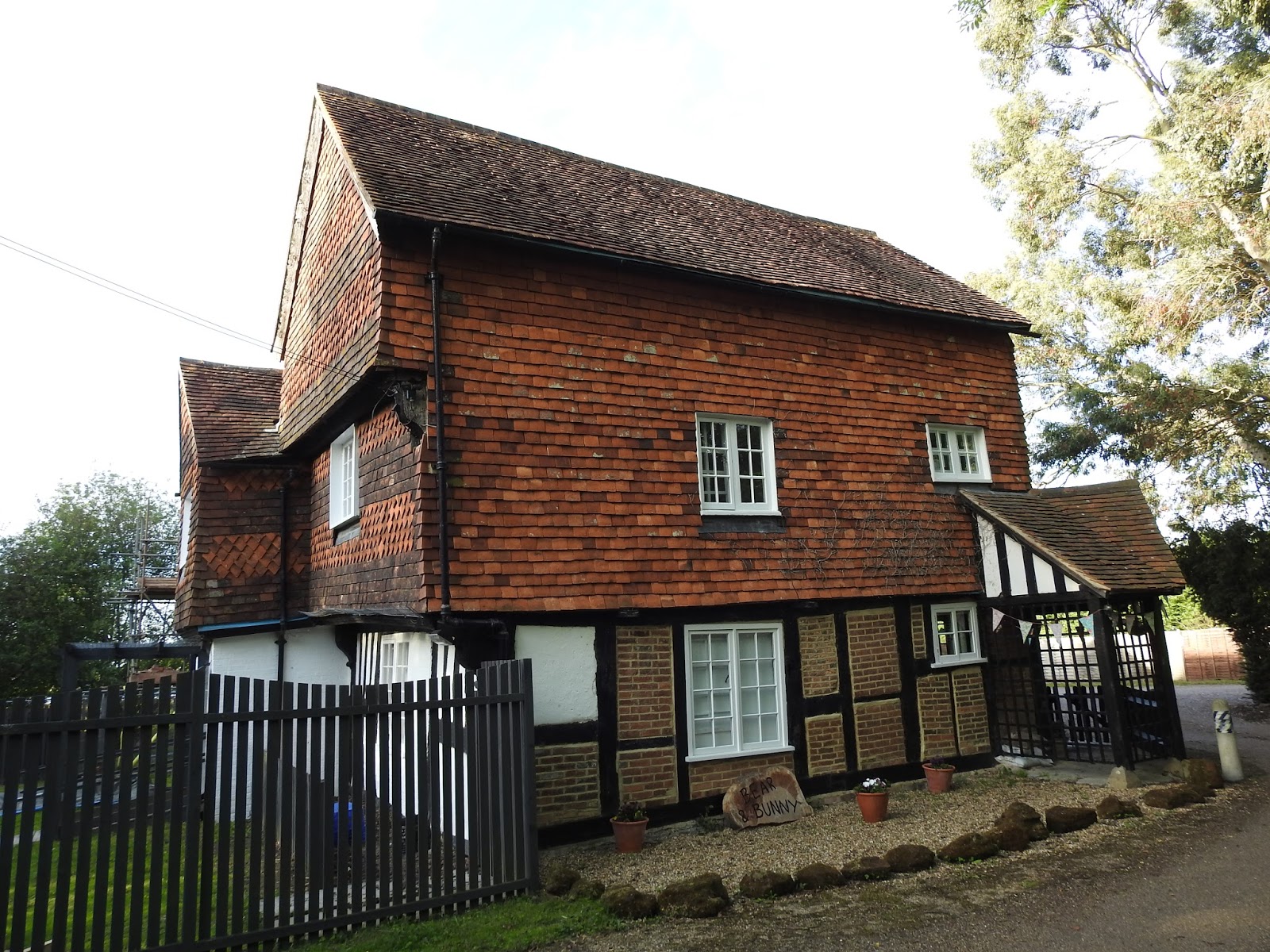
The core of this large building, now a nursery school, is an early-17th-century timber-framed house with jettying at one end and a tile-hung upper storey. The tiled roof uses Horsham stone. An extension was built in the same style in the 20th century.


Crawley Old Town home page

All photos by Ian Mulcahy. E-mail crawleyoldtown@gmail.com

Saturday, 29 April 2017

FOUR PICTURES: 8-10 Old Martyrs

Martyrs Farm, west of the London Road, was named after Protestant martyr Thomas Dungate who was arrested there in 1556 and burnt at the stake. The farmhouse, now two houses, has exposed timber-framing, a tile-hung upper floor and a substantial chimney. A 20th-century extension (no. 12, on the left) was built in the same style.


Crawley Old Town home page

All photos by Ian Mulcahy. E-mail crawleyoldtown@gmail.com

EIGHT PICTURES: County Oak Cottage

County Oak Cottage was built as a timber-framed cottage at the edge of Lowfield Heath in 1705, possibly as a conversion of an older barn. The building has been extended and converted into an office, but part of the original structure remains.          


Crawley Old Town home page

All photos by Ian Mulcahy. E-mail crawleyoldtown@gmail.com